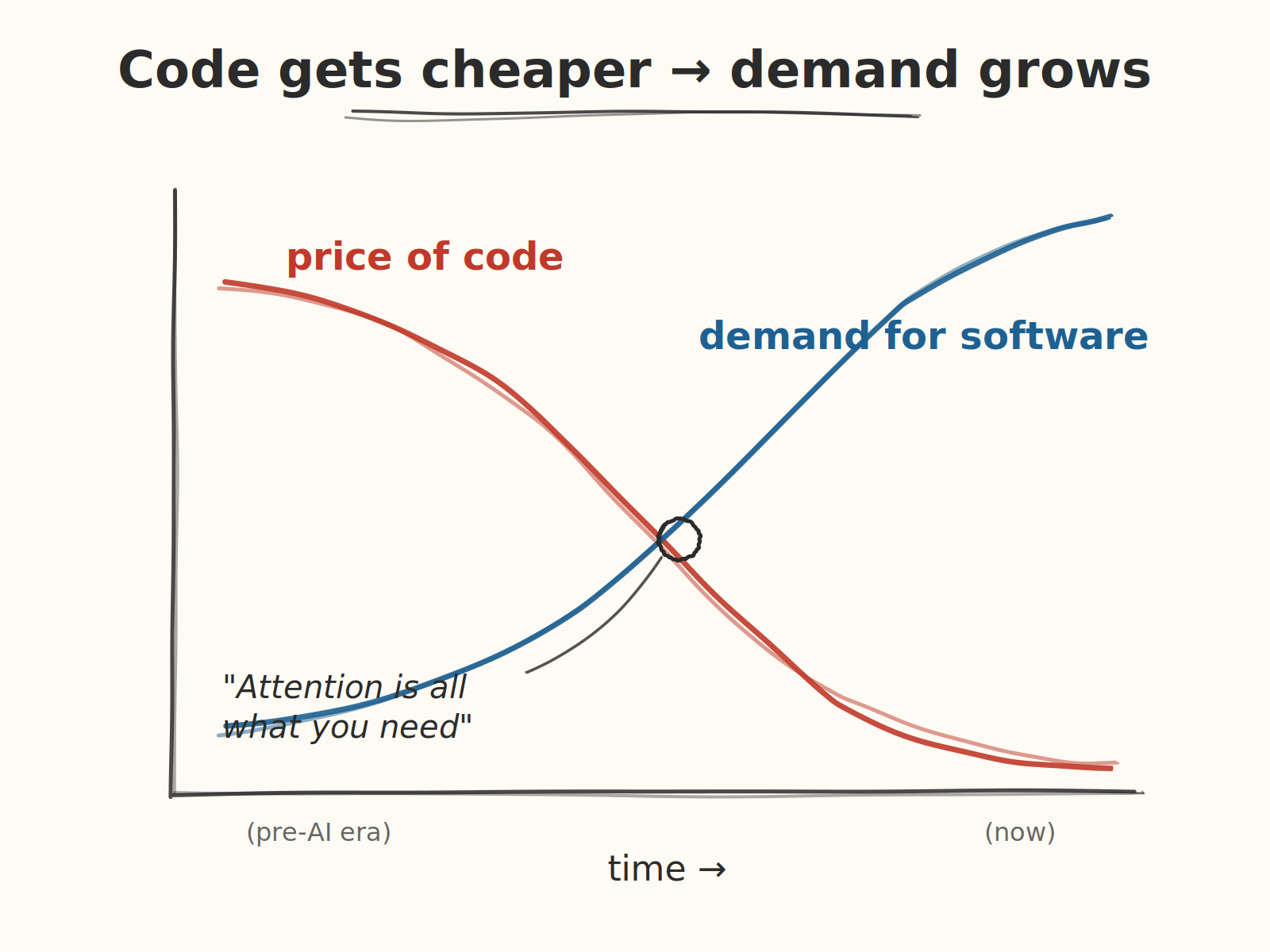
In 2011, Marc Andreessen declared that software is eating the world. Fifteen years later, the question has flipped: something is eating software itself, and that something is AI.
Writing code has become too cheap; this is a fact. Code is a formal language, and LLMs — since the 2017 “Attention Is All You Need” paper — have learned the whole internet by heart. They can dream text, which sounds convincing and is not wrong in most cases, and they can speak multiple languages.
I, a PM who hadn’t written real code for years, worked through the last few months on 4 projects at different complexity levels. 2 of them were within my company, and one is running just fine in the production pipeline.
The demand for code is clearly going up, and economics tells us why. When a good becomes cheaper, demand for it increases. As an analogy: cameras got radically cheaper and better; everyone has one; photos are infinite and near-free. People are still buying more cameras and taking more photos — and good photographers are more valuable than ever.
Software ≠ Code. Software is a solution that runs on a computer; this solution needs to have a purpose. Identifying the purpose is hard; often, neither the customer nor the dev teams know what to build. Along the way, frameworks and best practices were developed to define clearly and, most importantly, align on what to build.
The solution then needs to be coded in a way that the computer understands; it can be done in spaghetti style or using clean code. In both cases, the solution will serve its purpose, but in the former case, it will fail the test of time quickly, depending on how bad the code is. Smart engineers spent decades inventing ways to make solutions maintainable: testing, design patterns, static code analysis — you name it.
All those activities and artifacts are complementary to the code; code cannot live in a vacuum. To have meaningful software, they are needed as well. They didn’t get cheaper, though. Copilot won’t help you build the right thing faster. On the contrary, it helps you build many wrong things faster. Call it a diversion, or call it fast prototyping.
Those complements will become more expensive in my opinion, or at least economic theory tells us so. If there is a huge demand for cars in one city, tires become more expensive, not cheaper. Morgan Stanley analysts recently made a similar point: as code generation gets cheap, the scarce inputs shift elsewhere — to data, to judgment, to the specification of what is actually worth building.
We are in the middle of the euphoria and shock, still wrapping our heads around how the computer can one-shot code that used to take weeks to write. But that’s not software development. The craft still matters, and will matter even more.
Leave a Reply